
Welcome to Logistics Intelligence and Big Data Analysis
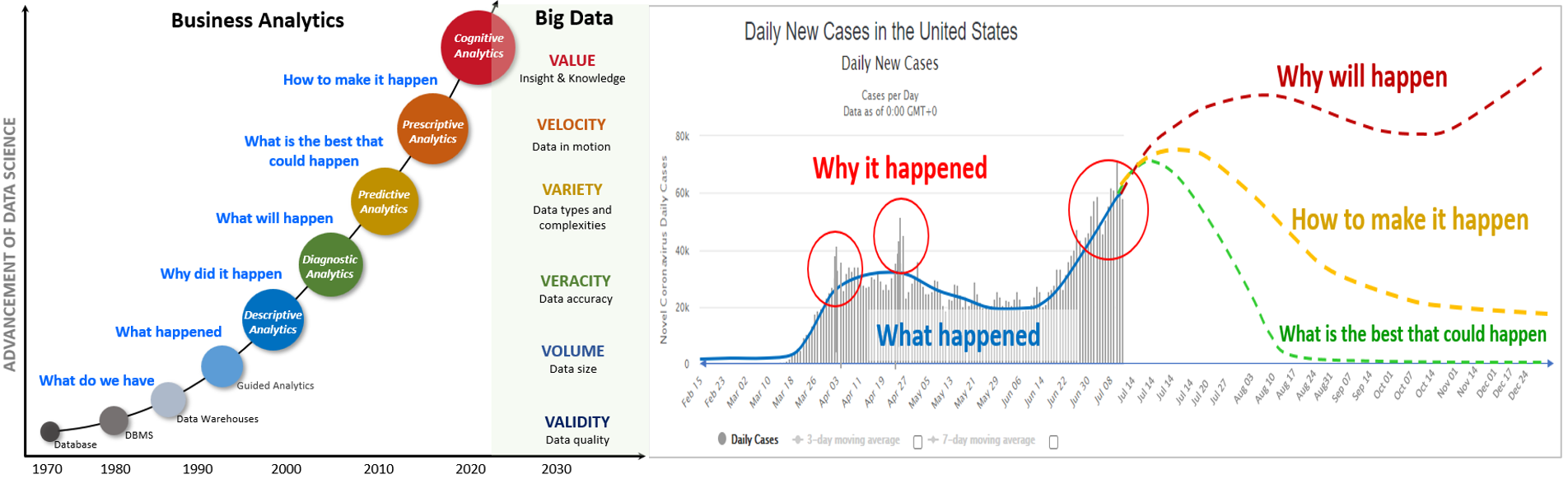
This course introduces some of the best practical methods and tools for creating business value using big data. It goes above algorithms or logistics into building data literacy, reasoning and analytics capability. This course focuses on your business questions, helping you identify which data could answer these questions, where the data is, how to find the right data from heterogeneous sources, and how to bring the data together, followed by addressing the right analytics models and how to apply them to deliver the right insight for the right stakeholders or decision makers. This course uses simple explanations to illustrate complex concepts such as data science, AI and Blockchain. It focuses on using open source tools to reason what has happened, why it happened, what is the best that could happen, and how you can make it happen. This course was established in 2015 and received 91% positive student feedback in 2018 and 100% in 2019.
This course is structured in five major sections:
- Using big data to investigate what has happened (Week 1 - 3)
- Using big data to find out why it happened (Week 4 - 7)
- Using big data to identify what will happen(Week 8 - 10)
- Using big data to predict what is the best that could happen (Week 11 & 12)
- Using big data to make it happen and future strategies (Week 13 & 14)
Descriptive Analytics is to describe the data using graphs, tables, or diagrams, it could be pie chart, line graph, or heat map, or data flow diagram, so that it can answer the question “What happened” in a simple way or via visualisation.
With modern tools introduced in this course, you can analyse big data and describe what has happened.
Big Data can be described and visualised to help interpret what has happened from the historical data:
- Better understand the historical changes that have occurred in a business;
- Show success or failure of a business in the past;
- Identify the operational or staff performance of an organisation;
- Provide the context that is vital for understanding data from a historical point of view;
- Allow us to learn from past user behaviour and understand how they might influence future outcomes;
- Reveal unique insights, trends and patterns from the current situation, and how they are compared to the other period.
Descriptive Analytics answers what has happened:
Essential Reading
- Textbook 1: Chapter 1
- Textbook 2: Chapter 1
- Week 1 Lecture Notes (Click to download the PPT slides)
Additional Youtube Learning Videos:
Essential Reading
- Textbook 2: Chapter 2 & 3
- Week 2 Lecture Notes - 1 (Click to download the PPT slides)
- Week 2 Lecture Notes - 2 (Click to download the PPT slides)
Additional Youtube Learning Videos:
Additional Article Readings:
- Steve LaValle et al (2011). Big Data, Analytics and the Path From Insights to Value. MIT Sloan Managment Review, Vol 52 No 2.
- Thomas H. Davenport et al (2013). Big Data in Big Companies. International institute for analytics.
Essential Reading
- Textbook 2: Chapter 3
- Week 3 Lecture Notes - 1 (Click to download the PPT slides)
- Week 3 Lecture Notes - 2 (Click to download the PPT slides)
Additional Youtube Learning Videos:
Additional Article Readings:
- Jeanne W. Ross et al (2013). You May Not Need Big Data After All. Harvard Business Review.
- Matt Asay (2014). Who Are Big Data’s Big Winners? You Might Be Surprised. Read Write Web.
Diagnostic Analytics is to explore the big data for the purpose of better understanding the causes of events and behaviours.
It answers the question “Why it happened” by drawing the connections and causations inside your dataset so that leaders can make the right decisions accordingly.
The key techniques, including correlation, regression, data clustering, root cause analysis, drill-down and drill-through, will be presented in this Module.
Diagnostic Analytics answers why it happened:
Essential Reading
- Textbook 1: Chapter 4 - Page 81-92, Page 102-109.
- Textbook 2: Chapter 7 - Page 295-302.
- Week 4 Lecture Notes - 1 (Click to download the PPT slides)
- Week 4 Lecture Notes - 2 (Click to download the PPT slides)
Additional Youtube Learning Videos:
Additional Article Readings:
- Koo Ping Shung (2018). Accuracy, Precision, Recall or F1?. Towards Data Science.
- Salma Ghoneim (2019). Accuracy, Recall, Precision, F-Score & Specificity, which to optimize on?. Towards Data Science.
Essential Reading
- Textbook 1: Chapter 6 - Page 141-173.
- Textbook 2: Chapter 4 - Page 139-147.
- Week 5 Lecture Notes - 1 (Click to download the PPT slides)
- Week 5 Lecture Notes - 2 (Click to download the PPT slides)
Additional Youtube Learning Videos:
Additional Article Readings:
- KZainol, Z., Marzukhi, S., Nohuddin, P. N., Noormaanshah, W. M., & Zakaria, O. (2017, November). Document Clustering in Military Explicit Knowledge: A Study on Peacekeeping Documents. In International Visual Informatics Conference(pp. 175-184). Springer, Cham.
- Zainol, Z., Azahari, A. M., Wani, S., Marzukhi, S., Nohuddin, P. N., & Zakaria, O. (2018). Visualizing Military Explicit Knowledge using Document Clustering Techniques. International Journal of Academic Research in Business and Social Sciences, 8(6), 1127-1143.
Essential Reading
- Textbook 1 - Page 233-235, 245-247
- Textbook 2 - Page 148-150, 167-176
- Week 6 Lecture Notes (Click to download the PPT slides)
Additional Youtube Learning Videos:
Additional Article Readings:
- Steve LaValle et al (2011). Big Data, Analytics and the Path From Insights to Value. MIT Sloan Managment Review, Vol 52 No 2.
- Thomas H. Davenport et al (2013). Big Data in Big Companies. International institute for analytics.
Essential Reading
- Week 7 Lecture Notes (Click to download the PPT slides)
Additional Youtube Learning Videos:
Additional Article Readings:
- Carolina Bento. (2018, May). Linear Regression In Real Life. Towards Data Science.
- Anirudh Sharma (2018, May). What are some real-world applications of “simple” linear regression. Quora.